

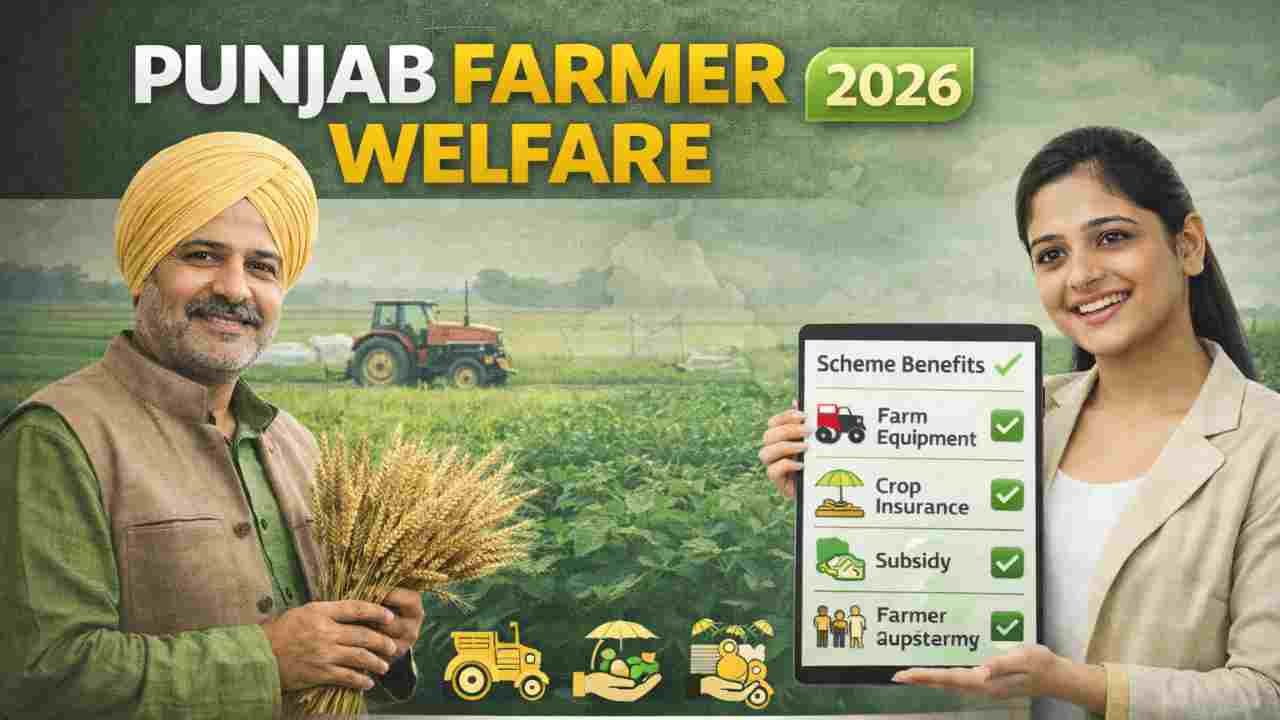
The Punjab Government operates multiple farmer-focused welfare schemes to support agricultural households across the state. Agriculture plays a central role in Punjab’s economy, and government initiatives aim to reduce financial risks, improve productivity, and strengthen rural livelihoods.
In 2026, Punjab farmer welfare schemes continue to address challenges such as rising input costs, income uncertainty, natural risks, and access to institutional support. This article provides a clear and realistic overview of Punjab farmer welfare schemes, their objectives, eligibility basics, benefits, and how farmers can understand the system better.
Why Farmer Welfare Schemes Are Important in Punjab
Farming in Punjab involves significant investment in seeds, fertilizers, machinery, irrigation, and labor. Farmer welfare schemes are designed to:
- Reduce financial stress on farming households
- Support sustainable agricultural practices
- Improve income stability
- Provide safety nets during crop loss or emergencies
- Promote rural development
These schemes aim to ensure long-term agricultural sustainability and farmer well-being.
Types of Farmer Welfare Schemes in Punjab
Punjab government farmer welfare schemes generally fall into several broad categories.
Financial Assistance and Income Support Schemes
These schemes provide financial relief or income-related assistance to farmers.
Common objectives include:
- Supporting farmers during low income periods
- Assisting small and marginal farmers
- Reducing dependence on informal credit
Support may be provided through direct transfers or structured assistance programs.
Crop Support and Risk Management Schemes
Crop-related schemes aim to protect farmers from losses due to unpredictable factors.
These schemes focus on:
- Crop damage due to natural conditions
- Stabilizing farmer income during adverse situations
- Encouraging timely crop management
Such programs help reduce uncertainty in farming activities.
Agricultural Input Subsidy Schemes
To lower cultivation costs, some schemes provide subsidies for:
- Seeds and fertilizers
- Agricultural machinery and tools
- Irrigation and water management equipment
Subsidies help farmers adopt better inputs without excessive financial burden.
Irrigation and Water Management Schemes
Efficient water use is essential in Punjab’s agriculture.
Water-related schemes aim to:
- Improve irrigation infrastructure
- Promote efficient water usage
- Support sustainable farming practices
These initiatives help address water scarcity and resource management.
Soil Health and Sustainable Farming Programs
Sustainable agriculture programs focus on:
- Soil testing and soil health improvement
- Balanced fertilizer usage
- Long-term land productivity
Such schemes encourage environmentally responsible farming.
Who Can Benefit from Punjab Farmer Welfare Schemes?
Eligibility criteria vary by scheme, but generally include:
- Permanent residency in Punjab
- Engagement in agricultural activities
- Ownership or lease of agricultural land (where required)
- Compliance with income or category criteria
Small and marginal farmers are often given priority under welfare programs.
Common Benefits Provided to Farmers
Punjab farmer welfare schemes may offer benefits such as:
- Financial assistance or subsidies
- Support for crop cultivation and protection
- Access to government-approved resources
- Training and awareness programs
Benefits depend on the specific scheme and official guidelines.
Documents Commonly Required for Farmer Schemes
Farmers may need to submit documents for verification.
Typical documents include:
- Identity proof
- Residence proof
- Land ownership or lease records
- Bank account details
- Crop or agricultural activity details
Document requirements differ across schemes.
How Farmer Welfare Schemes Are Implemented
Implementation usually happens through:
- Agriculture department offices
- Authorized service centers
- Official government portals
Verification ensures that benefits reach eligible farmers transparently.
Challenges Faced by Farmers During Scheme Access
Farmers may face issues such as:
- Lack of awareness about scheme details
- Documentation delays
- Verification-related challenges
- Limited digital access in rural areas
Government outreach programs aim to reduce these gaps.
Importance of Official Information Sources
Farmers are advised to:
- Rely on official government announcements
- Avoid unofficial agents promising guaranteed benefits
- Follow department guidelines carefully
Official sources provide accurate and updated information.
Role of Digital Platforms in Farmer Welfare
Digital initiatives help by:
- Simplifying application processes
- Improving transparency
- Reducing processing time
However, offline support remains important for many rural farmers.
Tips for Farmers Applying for Welfare Schemes
- Keep land and identity records updated
- Monitor official scheme notifications
- Ensure accurate information submission
- Seek help from authorized centers when needed
Preparedness improves success rates.
Frequently Asked Questions (FAQs)
Q1. Are Punjab farmer welfare schemes available to all farmers?
No. Eligibility depends on scheme-specific criteria such as landholding size and income.
Q2. Can a farmer benefit from multiple schemes?
Yes, if eligibility conditions are met for different schemes.
Q3. Do schemes change every year?
Some schemes continue annually, while others may be updated or replaced.
Q4. Is land ownership mandatory for all schemes?
Not always. Some schemes also cover tenant or sharecroppers as defined.
Q5. How can farmers verify scheme eligibility?
Official agriculture department portals and offices provide verified information.
Conclusion
Punjab farmer welfare schemes in 2026 continue to support agricultural households through financial assistance, crop support, subsidies, and sustainable farming initiatives. Understanding scheme categories, eligibility basics, and official processes helps farmers make informed decisions.
Farmers are encouraged to stay informed through official government sources and follow guidelines carefully for maximum benefit.
